

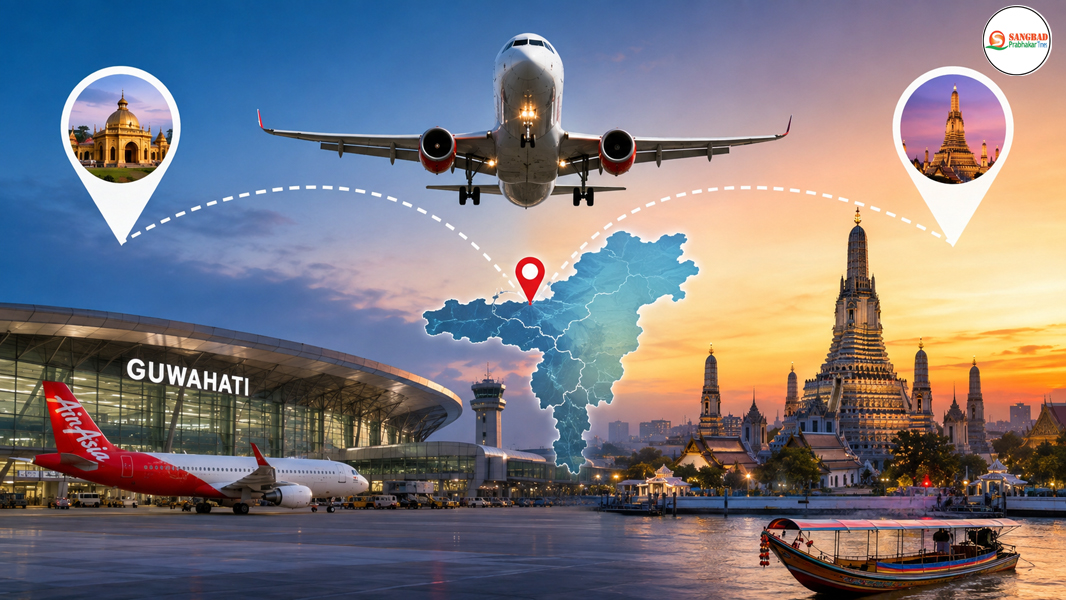


অক্টোবর–নভেম্বরে দুই সরাসরি উড়ান—উত্তর–পূর্ব ভারতের আন্তর্জাতিক যাত্রাপথ কি এবার কলকাতাকে পাশ কাটাতে শুরু করবে?

Published on: সেপ্টে ২, ২০২৬ at ২০:৪০
অনিরুদ্ধ পাল | সংবাদ প্রভাকর টাইমস
এসপিটি নিউজ, কলকাতা, ২ সেপ্টেম্বর: একসময় উত্তর-পূর্ব ভারতের আন্তর্জাতিক বিমানযাত্রার কথা উঠলেই কলকাতার নাম অনিবার্যভাবে সামনে আসত। গুয়াহাটি, শিলং, ইম্ফল কিংবা উত্তর-পূর্ব ভারতের অন্য শহর থেকে বিদেশ যেতে হলে কলকাতায় এসে বিমান বদল করা ছিল বহু যাত্রীর কাছে প্রায় স্বাভাবিক রুট।
কিন্তু সেই চিত্র দ্রুত বদলাতে শুরু করেছে। গুয়াহাটির সঙ্গে একের পর এক আন্তর্জাতিক গন্তব্যের সরাসরি বিমান যোগাযোগ তৈরি হচ্ছে। আর এবার সেই তালিকায় ব্যাঙ্কককে ঘিরে তৈরি হয়েছে বিশেষ তাৎপর্য।
২৭ অক্টোবর থেকে গুয়াহাটি ও ব্যাঙ্ককের মধ্যে সরাসরি পরিষেবা শুরু করছে ইন্ডিগো। তার কয়েক সপ্তাহ পর ১৬ নভেম্বর থেকে থাই এয়ারএশিয়া গুয়াহাটি থেকে ব্যাঙ্ককের ডন মুয়াং বিমানবন্দরে সরাসরি উড়ান চালু করবে। থাই এয়ারএশিয়ার নির্ধারিত পরিষেবা সপ্তাহে চার দিন—সোমবার, বুধবার, শুক্রবার ও রবিবার। গুয়াহাটি থেকে উড়ান ছাড়বে রাত ১১টা ৪০ মিনিটে এবং পরদিন ভোর ৩টা ৫০ মিনিটে ব্যাঙ্ককে পৌঁছবে। যাত্রাসময় প্রায় ২ ঘণ্টা ৪০ মিনিট।
অর্থাৎ কয়েক সপ্তাহের মধ্যেই গুয়াহাটি থেকে ব্যাঙ্ককের দিকে একাধিক সরাসরি পরিষেবার দরজা খুলছে।
প্রশ্ন তাই স্বাভাবিক— গুয়াহাটি কি ধীরে ধীরে উত্তর-পূর্ব ভারতের নতুন আন্তর্জাতিক বিমান-প্রবেশদ্বার হয়ে উঠছে? আর সেই সঙ্গে কলকাতার দীর্ঘদিনের আঞ্চলিক ‘হাব’ ভূমিকা কি চাপের মুখে পড়ছে?
শুধু একটি উড়ান নয়, বদলটা তার চেয়ে বড়
একটি আন্তর্জাতিক উড়ান চালু হওয়াকে সাধারণত নতুন পরিষেবা হিসেবে দেখা হয়। কিন্তু গুয়াহাটির ক্ষেত্রে বিষয়টি আলাদা। কারণ ব্যাঙ্কক পরিষেবা আসছে এমন একটি সময়ে, যখন শহরটির আন্তর্জাতিক বিমান যোগাযোগ ইতিমধ্যেই সম্প্রসারিত হচ্ছে।
দুবাই, আবুধাবি, সিঙ্গাপুর এবং ব্যাঙ্ককের মতো আন্তর্জাতিক গন্তব্যের সঙ্গে গুয়াহাটির সরাসরি যোগাযোগ উত্তর-পূর্ব ভারতের যাত্রীদের জন্য নতুন বিকল্প তৈরি করছে। আর সরাসরি বিমান পরিষেবার সবচেয়ে বড় সুবিধা হল—কলকাতা, দিল্লি বা অন্য কোনও বড় শহরে বিমান বদলের প্রয়োজন কমে যাওয়া।
একজন অসমের পর্যটক যদি সরাসরি গুয়াহাটি থেকে ব্যাঙ্ককে পৌঁছতে পারেন, তাহলে কলকাতা হয়ে যাওয়ার অর্থনৈতিক ও সময়গত সুবিধা স্বাভাবিকভাবেই কমে যায়।
থাই এয়ারএশিয়ার পরিষেবা কেন গুরুত্বপূর্ণ?
থাই এয়ারএশিয়ার নির্ধারিত গুয়াহাটি–ব্যাঙ্কক পরিষেবা শুধু একটি নতুন আন্তর্জাতিক সংযোগ নয়, এটি সরাসরি প্রতিযোগিতামূলক বিমানবাজার তৈরিরও ইঙ্গিত।
প্রকাশিত সূচি অনুযায়ী, ১৬ নভেম্বর থেকে পরিষেবাটি শুরু হবে এবং সপ্তাহে চার দিন চলবে। একই পথে সরাসরি যাত্রার সময় প্রায় ২ ঘণ্টা ৪০ মিনিট।
এয়ারএশিয়ার নিজস্ব সংরক্ষণ ব্যবস্থাতেও নভেম্বরের একাধিক তারিখে সরাসরি গুয়াহাটি–ব্যাঙ্কক উড়ানের ভাড়া প্রায় ১৩,৮৩৮ টাকা থেকে দেখা যাচ্ছে। তবে বিমানভাড়া তারিখ, চাহিদা ও আসনপ্রাপ্যতার সঙ্গে পরিবর্তিত হবে। অর্থাৎ আন্তর্জাতিক যাত্রা শুধু সহজই হচ্ছে না, তুলনামূলক কম খরচে সরাসরি যাত্রার সম্ভাবনাও তৈরি হচ্ছে।
কলকাতার জন্য আসল উদ্বেগ কোথায়?
কলকাতার সমস্যা ব্যাঙ্ককের একটি বা দুটি নতুন উড়ান নয়।
আসল বিষয় হল যাত্রী প্রবাহের পরিবর্তন।
যদি উত্তর-পূর্ব ভারতের যাত্রীরা নিজেদের অঞ্চল থেকেই সরাসরি দক্ষিণ-পূর্ব এশিয়া, মধ্যপ্রাচ্য ও ভবিষ্যতে পূর্ব এশিয়ার বিভিন্ন গন্তব্যে যেতে পারেন, তাহলে কলকাতা হয়ে আন্তর্জাতিক যাত্রার প্রয়োজন ধীরে ধীরে কমবে।
এটি প্রথমে ছোট পরিবর্তন হতে পারে। তারপর তা বড় বাজারে পরিণত হতে পারে। আর বিমান পরিষেবার বাজারে একটি রুটের যাত্রী হারানো মানে শুধু কয়েক হাজার যাত্রী হারানো নয়। তার সঙ্গে যুক্ত থাকে—
- বিমানবন্দর ব্যবহার
- সংযোগকারী বিমান পরিষেবা
- হোটেল
- যাত্রী পরিবহণ
- পর্যটন ব্যবসা
- বিমান সংস্থার ভবিষ্যৎ রুট পরিকল্পনা
- আন্তর্জাতিক পর্যটক প্রবাহ
অর্থাৎ একটি সরাসরি আন্তর্জাতিক উড়ান আঞ্চলিক অর্থনীতির গতিপথেও প্রভাব ফেলতে পারে।
কিন্তু কলকাতা কি সত্যিই পিছিয়ে পড়ছে?
এখানে উত্তরটি সরল নয়।
না—এই মুহূর্তে কলকাতার গুরুত্ব কমে যাচ্ছে বলে সিদ্ধান্তে পৌঁছনোর মতো তথ্য নেই। বরং বাস্তবতা হল, কলকাতা এবং গুয়াহাটির ভূমিকা আলাদা।
কলকাতা এখনও পূর্ব ভারতের বৃহত্তর আন্তর্জাতিক বিমানকেন্দ্র। পশ্চিমবঙ্গের পাশাপাশি বিহার, ঝাড়খণ্ড, ওড়িশা এবং পূর্ব ভারতের বিস্তৃত অঞ্চলের আন্তর্জাতিক যাত্রীরা কলকাতার উপর নির্ভর করেন।
কলকাতার আন্তর্জাতিক গন্তব্যের সংখ্যাও গুয়াহাটির তুলনায় অনেক বেশি। অর্থাৎ গুয়াহাটি এখনও কলকাতার সমান মাপের আন্তর্জাতিক বিমানকেন্দ্র হয়ে ওঠেনি।
কিন্তু চ্যালেঞ্জের বিষয়টি অন্য জায়গায়। গুয়াহাটি উত্তর-পূর্ব ভারতের যাত্রীদের জন্য কলকাতার বিকল্প হয়ে উঠছে। এটাই সবচেয়ে গুরুত্বপূর্ণ পরিবর্তন।
গুয়াহাটির সবচেয়ে বড় সুবিধা—ভূগোল
বিমান পরিবহণে ভূগোল অত্যন্ত গুরুত্বপূর্ণ। অসম, মেঘালয়, অরুণাচল প্রদেশ, নাগাল্যান্ড, মণিপুর, মিজোরাম ও ত্রিপুরার একটি বড় অংশের জন্য গুয়াহাটি স্বাভাবিক আঞ্চলিক প্রবেশদ্বার। তাই গুয়াহাটি থেকে আন্তর্জাতিক বিমান পরিষেবা বাড়লে শুধু অসমের যাত্রী নয়, গোটা উত্তর-পূর্ব ভারতের একটি বড় অংশ উপকৃত হতে পারে।
এখানেই কলকাতার সঙ্গে সরাসরি প্রতিযোগিতার জায়গাটি তৈরি হচ্ছে।
আজ যদি ব্যাঙ্কক হয়, আগামী দিনে যদি কুয়ালালামপুর, হ্যানয়, জাকার্তা, ম্যানিলা কিংবা আরও পূর্ব এশীয় গন্তব্য যুক্ত হয়, তাহলে ছবিটি আরও বদলাতে পারে।
নতুন বিমানবন্দর পরিকাঠামো কি গুয়াহাটিকে আরও এগিয়ে দেবে?
সম্ভাবনা যথেষ্ট। গুয়াহাটির নতুন বিমানবন্দর পরিকাঠামো আন্তর্জাতিক সম্প্রসারণের জন্য বাড়তি সক্ষমতা তৈরি করছে। এর ফলে বিমান সংস্থাগুলির কাছে নতুন আন্তর্জাতিক রুট চালুর সুযোগ বাড়ছে। এখানে সবচেয়ে গুরুত্বপূর্ণ বিষয় হল— পরিকাঠামো আগে তৈরি হয়েছে, এখন সেই পরিকাঠামোকে আন্তর্জাতিক রুট দিয়ে পূরণ করার পালা।
ব্যাঙ্কক সেই প্রক্রিয়ার গুরুত্বপূর্ণ অংশ।
যদি আন্তর্জাতিক যাত্রীসংখ্যা বাড়ে এবং বিমান সংস্থাগুলি রুটগুলিকে লাভজনক মনে করে, তাহলে আরও নতুন গন্তব্য যুক্ত হওয়ার সম্ভাবনা তৈরি হবে।
পর্যটন শিল্পে প্রভাব হতে পারে আরও বড়
গুয়াহাটি যদি আন্তর্জাতিক বিমান-প্রবেশদ্বার হয়ে ওঠে, তাহলে সবচেয়ে বড় লাভবান হতে পারে উত্তর-পূর্ব ভারতের পর্যটন। বিদেশি পর্যটকদের জন্য উত্তর-পূর্ব ভারতের দরজা তখন সরাসরি খুলে যাবে। ব্যাঙ্কক থেকে একজন পর্যটক সরাসরি গুয়াহাটিতে এসে কাজিরাঙা যেতে পারেন। সেখান থেকে মেঘালয়। অথবা অরুণাচল প্রদেশ। অথবা নাগাল্যান্ড। অর্থাৎ ভবিষ্যতের সম্ভাব্য পর্যটনপথ হতে পারে—
দক্ষিণ-পূর্ব এশিয়া → গুয়াহাটি → উত্তর-পূর্ব ভারত।
এটি উত্তর-পূর্ব ভারতের পর্যটন অর্থনীতিতে বড় পরিবর্তন আনতে পারে।
কলকাতার সামনে তাই এখন নতুন প্রশ্ন
কলকাতার জন্য সবচেয়ে বড় প্রশ্ন গুয়াহাটি কতগুলি আন্তর্জাতিক উড়ান চালু করছে, তা নয়।
প্রশ্ন হল- কলকাতা আগামী দিনে কতটা নতুন আন্তর্জাতিক যাত্রী আকর্ষণ করতে পারবে? আরও আন্তর্জাতিক গন্তব্য কি যুক্ত হবে? নতুন বিমান সংস্থা কি আসবে? দক্ষিণ-পূর্ব এশিয়া ও পূর্ব এশিয়ার সঙ্গে কি আরও সরাসরি যোগাযোগ তৈরি হবে? আন্তর্জাতিক যাত্রীদের জন্য কলকাতা কি আরও প্রতিযোগিতামূলক ভাড়া ও উন্নত সংযোগ দিতে পারবে?
এই প্রশ্নগুলির উত্তরই ঠিক করবে আগামী দিনে কলকাতার অবস্থান।
একটি নতুন ‘দুই কেন্দ্রের’ বিমান মানচিত্র?
সম্ভবত ভবিষ্যতের সবচেয়ে বাস্তবসম্মত ছবি এটিই। কলকাতা থাকবে পূর্ব ভারতের বৃহত্তর আন্তর্জাতিক বিমানকেন্দ্র হিসেবে। আর গুয়াহাটি গড়ে উঠতে পারে উত্তর-পূর্ব ভারতের আন্তর্জাতিক প্রবেশদ্বার হিসেবে। অর্থাৎ প্রতিযোগিতা থাকলেও দুই শহর একে অপরের সম্পূর্ণ বিকল্প নয়।
বরং তৈরি হতে পারে একটি নতুন আঞ্চলিক বিমান কাঠামো—
কলকাতা — পূর্ব ভারতের আন্তর্জাতিক কেন্দ্র
গুয়াহাটি — উত্তর-পূর্ব ভারতের আন্তর্জাতিক প্রবেশদ্বার। কিন্তু এর মধ্যে যে প্রতিযোগিতা থাকবে, তা নিয়ে সন্দেহ নেই।
ব্যাঙ্কক হয়তো শুরু মাত্র
গুয়াহাটি–ব্যাঙ্কক সরাসরি পরিষেবা তাই নিছক একটি বিমান রুটের খবর নয়।
এটি একটি বৃহত্তর পরিবর্তনের সম্ভাব্য সূচনা।
যদি এই রুট সফল হয়, যাত্রীসংখ্যা বাড়ে এবং বিমান সংস্থাগুলি উত্তর-পূর্ব ভারতের বাজারে সম্ভাবনা দেখতে পায়, তাহলে আরও আন্তর্জাতিক গন্তব্যের দরজা খুলতে পারে।
তখন কলকাতার জন্যও বার্তা হবে স্পষ্ট—
উত্তর-পূর্ব ভারতের আন্তর্জাতিক যাত্রীরা আর শুধু কলকাতার উপর নির্ভরশীল নন।
তাঁদের সামনে বিকল্প তৈরি হচ্ছে।
আর বিমান পরিবহণের বাজারে বিকল্প তৈরি হওয়াই প্রতিযোগিতার প্রথম ধাপ।
শেষ কথা
গুয়াহাটি এখনও কলকাতার জায়গা নিয়ে নেয়নি।
কিন্তু কলকাতার একচেটিয়া আঞ্চলিক সুবিধার জায়গায় একটি শক্তিশালী বিকল্প তৈরি হচ্ছে—এটাই এখন সবচেয়ে গুরুত্বপূর্ণ সত্য।
ব্যাঙ্ককগামী নতুন পরিষেবা সেই পরিবর্তনের দৃশ্যমান প্রমাণ।
আগামী কয়েক বছর তাই শুধু বিমান সংস্থাগুলির জন্য নয়, পূর্ব ও উত্তর-পূর্ব ভারতের পর্যটন শিল্পের জন্যও অত্যন্ত গুরুত্বপূর্ণ হতে চলেছে।
প্রশ্ন আর শুধু—
“গুয়াহাটি থেকে কোথায় বিমান যাবে?”
প্রশ্নটা এখন আরও বড়—
“উত্তর–পূর্ব ভারতের আন্তর্জাতিক যাত্রীরা আগামী দিনে কোন শহরকে তাঁদের প্রধান আকাশদ্বার হিসেবে বেছে নেবেন—গুয়াহাটি, না কলকাতা?”
এই উত্তরই হয়তো বদলে দেবে পূর্ব ভারতের ভবিষ্যৎ বিমান মানচিত্র।
Published on: সেপ্টে ২, ২০২৬ at ২০:৪০
Guwahati’s Bangkok Push: Is Kolkata’s Aviation Hub Facing a New Challenge?
Two new direct Bangkok services signal a shift in Northeast India’s air map, but Kolkata remains far ahead in international connectivity
By Aniruddha Pal | Sangbad Prabhakar Times
SPT NEWS, KOLKATA/GUWAHATI, India — India’s eastern aviation map may be entering a new phase.
For decades, Kolkata has functioned as the principal international gateway for much of eastern and northeastern India, with passengers from the Northeast frequently travelling through the city to reach destinations across Southeast Asia, the Middle East and beyond.
That dependence is now beginning to change.
Guwahati, the largest aviation centre in Northeast India, is rapidly expanding its international connectivity. The latest development is the addition of Bangkok, with IndiGo set to begin direct Guwahati–Bangkok services from October 27, followed by Thai AirAsia’s direct service to Bangkok’s Don Mueang airport from November 16.
The developments raise a larger question for the region’s aviation industry:
Could Guwahati eventually reduce Kolkata’s long-standing dominance as the international gateway for Northeast India?
The answer, for now, is not a simple yes.
But the direction of travel is becoming increasingly clear.
Bangkok marks a significant expansion
Assam Chief Minister Himanta Biswa Sarma announced on August 28 that IndiGo would launch direct flights between Guwahati and Bangkok from October 27.
He described the service as another gateway to Southeast Asia and said it would provide a boost to tourism, trade and travel.
The development will be followed by Thai AirAsia’s service from November 16.
According to the airline’s current booking system, the Guwahati–Bangkok Don Mueang service is scheduled to operate directly, with a flight time of around two hours and 40 minutes. Published schedules show departures from Guwahati at 11:40 p.m., arriving in Bangkok at 3:50 a.m. the following day.
The service is scheduled four days a week.
AirAsia’s current booking inventory also shows fares of around ₹13,838 on several November dates, although fares remain dynamic and can change according to demand and availability.
For passengers in the Northeast, the significance is straightforward: an international journey that once required a connection through another Indian metropolitan airport can increasingly begin directly from Guwahati.
The bigger story is not Bangkok
Bangkok is important, but it is only one part of a much larger transformation.
Guwahati’s new airport infrastructure has been designed with international expansion in mind.
The newly developed terminal at Lokpriya Gopinath Bordoloi International Airport has an annual passenger-handling capacity of about 13.1 million, and airport authorities have positioned Guwahati as a major aviation gateway for the Northeast as well as for South and Southeast Asia.
At the time of its opening, the new terminal was associated with 21 domestic and three international routes.
Since then, international connectivity has continued to expand, including services to destinations such as Singapore, Dubai and Abu Dhabi, with Bangkok now becoming another major addition.
The significance of this expansion goes beyond passenger convenience.
It suggests that Guwahati is being positioned not merely as a regional airport but as an international gateway for the entire Northeast.
Why this matters to Kolkata
Kolkata’s traditional advantage has been its geography.
The city has historically connected eastern India with the Northeast and served as an important international gateway to Southeast Asia and the Middle East.
But aviation markets change when passengers are given direct alternatives.
If travellers from Assam, Meghalaya, Arunachal Pradesh, Nagaland, Manipur, Mizoram and Tripura can increasingly fly internationally from Guwahati, their need to travel first to Kolkata may gradually decline.
That could affect not only passenger numbers but also connecting traffic, airline scheduling decisions, tourism flows and airport economics.
The question, therefore, is not whether Kolkata will suddenly lose its importance.
It is whether some of the traffic that historically flowed through Kolkata will increasingly remain within the Northeast.
Kolkata still holds a substantial lead
Despite Guwahati’s rapid expansion, Kolkata remains considerably larger in terms of international connectivity.
Current route data shows Kolkata connected to a much broader network of international destinations, including Bangkok, Singapore, Dubai, Abu Dhabi, Kuala Lumpur and several other major Asian and Middle Eastern centres.
Bangkok alone has multiple direct services from Kolkata, operated by several airlines, including Thai carriers and Indian operators.
Kolkata also serves a much larger overall metropolitan and regional passenger market.
An Airports Authority of India/AERA forecast for 2025-26 projected Kolkata airport traffic at more than 31.8 million passengers, including about 3.78 million international passengers.
That scale remains difficult for Guwahati to match in the near term.
Therefore, describing Guwahati as a replacement for Kolkata would be premature.
The more realistic possibility is the emergence of two complementary aviation centres.
From one gateway to two
The future eastern aviation map could increasingly resemble a two-centre system.
Kolkata
A major international gateway for eastern India, with a large passenger base, extensive international connections and strong links to the rest of India.
Guwahati
An emerging international gateway focused primarily on Northeast India and its growing links with Southeast Asia and the Middle East.
Such a model could reduce the traditional dependence of the Northeast on Kolkata without necessarily undermining Kolkata’s broader regional importance.
In other words, Guwahati does not necessarily have to replace Kolkata.
It only needs to capture a significant share of traffic that previously had no alternative.
The tourism equation could be even bigger
The aviation shift could have an especially strong impact on tourism.
For decades, the Northeast has struggled with accessibility compared with India’s better-connected tourist destinations.
Direct international flights could change that equation.
A traveller from Thailand, for example, could potentially reach Guwahati directly and then travel onwards to Kaziranga, Meghalaya, Arunachal Pradesh, Nagaland or other destinations across the region.
The potential travel chain is therefore much larger than a simple Guwahati–Bangkok connection:
Southeast Asia → Guwahati → Northeast India
If airlines add more direct routes from Guwahati, international tourism could increasingly enter the Northeast without passing through Kolkata or Delhi.
That could create new opportunities for hotels, tour operators, transport companies, local guides and destination businesses.
The next battle will be for Southeast Asia
Bangkok may be only the beginning.
The real test for Guwahati will be whether the airport can sustain and expand international demand.
If Bangkok, Singapore, Dubai and Abu Dhabi services perform strongly, airlines could have greater incentives to examine additional destinations.
Potential markets across Southeast and East Asia could become strategically important.
For Kolkata, that would mean a new competitive environment.
The city would no longer be the only obvious international aviation gateway for travellers from the Northeast.
For Guwahati, however, the challenge will be equally significant: converting geographical advantage into sustained passenger demand.
Connectivity alone will not decide the winner
A new international route does not automatically become a successful route.
Airlines will look closely at passenger loads, yields, seasonality, aircraft utilisation, tourism demand and connecting traffic.
The same will apply to Guwahati.
If international services consistently attract strong demand, more routes are likely to follow.
If demand remains limited, expansion could slow.
Kolkata, meanwhile, retains a powerful advantage in network depth.
Its extensive domestic connectivity allows international airlines and passengers to access a much larger catchment area.
Guwahati’s advantage is different.
Its strength lies in being geographically closer to the passengers and destinations of the Northeast.
A structural shift rather than a sudden displacement
The evidence therefore points towards evolution rather than an overnight change.
Kolkata is unlikely to lose its position as eastern India’s major international aviation centre simply because Guwahati has gained Bangkok.
But Guwahati is increasingly challenging the old assumption that passengers from the Northeast must travel through Kolkata before flying abroad.
That is a meaningful structural change.
The more international routes Guwahati gains, the stronger the argument becomes for passengers to begin their overseas journeys locally.
And every successful direct route strengthens the business case for the next one.
What happens next could reshape the region
The next few years will be crucial.
If Guwahati succeeds in building a sustainable international network, Northeast India could develop its own aviation ecosystem rather than remaining dependent on metropolitan gateways elsewhere.
That could bring substantial economic benefits to the region.
For Kolkata, meanwhile, the message is equally clear.
The city will need to continue expanding its international network, improving passenger experience and strengthening its position as a gateway between India, Southeast Asia and the wider Asia-Pacific region.
The competition may ultimately benefit both cities.
The bottom line
Guwahati is not replacing Kolkata—yet.
But it is changing the rules.
The arrival of direct Bangkok services, following the expansion of links with other international destinations, means that Northeast India is gradually gaining the ability to connect directly with the world.
For Kolkata, the challenge is not that passengers will suddenly disappear.
The challenge is that the Northeast may no longer need Kolkata to the same extent as before.
And that could be the beginning of a much bigger transformation.
The eastern Indian aviation map may be moving away from a single dominant gateway towards a new model:
Kolkata as the major international gateway of Eastern India.
Guwahati as the emerging international gateway of Northeast India.
The question is no longer whether Guwahati can fly internationally.
The real question is how much of Northeast India’s international traffic it can keep at home.